Software only
Boost, fuel, spark and throttle response recalibrated inside the factory hardware's headroom. No parts, no downtime, fully reversible.
A stage is not a power number. It is how much hardware the calibration has to work with. Here is what changes at each step, what it costs you in install time, and where the factory turbo stops being the limit.
Wheel horsepower against engine speed. Same car, same day, 93 octane, 28 °C ambient — stock pull first, each stage layered on top.
Boost, fuel, spark and throttle response recalibrated inside the factory hardware's headroom. No parts, no downtime, fully reversible.
The calibration runs out of air before it runs out of turbo. Downpipe, intake and charge cooling let the stock turbo hold target boost to redline.
Upgraded turbocharger and the fuel system to feed it. The file is built around your hardware and logged on the car — never pulled off a shelf.
| Metric | Stage 1 | Stage 2 | Stage 3 |
|---|---|---|---|
| Typical gain | +68 whp | +118 whp | +240 whp |
| Peak boost | 20 psi | 22 psi | 28 psi |
| Hardware | None | Downpipe · intake · cooling | Turbo · fuelling · cooling |
| Install time | 40 min | 2.5 h | 14–20 h |
| Fuel | 93 octane | 93 / E30 | E85 or race |
| Gearbox file | Recommended | Recommended | Required |
| Calibration | Off-the-shelf | Off-the-shelf | Custom, logged per car |
| Road legal | Yes | OPF-back only | Track only |
| Return to stock | Unlimited | Unlimited | Unlimited (file only) |
The same six questions asked of each stage: what the file touches, what you have to buy, how it drives, what it costs you in servicing, who it suits, and where it stops.
The factory calibration is written for the worst fuel, the hottest day and the least maintained example of your car anywhere it is sold. Stage 1 spends the margin that was left in it, and nothing else changes.
Stage 2 is not a bigger file. It is the same turbo asked to do the same job with the restrictions removed — a freer exhaust path, colder charge air, and a calibration written on the assumption that both are there.
Stage 1 and 2 work the factory turbo harder. Stage 3 replaces it, and then rebuilds everything downstream that was sized for the old one — fuel, cooling, clutch, and a calibration written against your car rather than your platform.
A modern high-performance car is calibrated across several control modules. Flashing the engine ECU alone leaves the gearbox and the driveline making factory decisions about the torque you just added.
Boost targets, fuel, spark, torque limiters and throttle mapping. The layer everyone means when they say tune.
Clutch pressure, shift logic, launch behaviour and manual-mode hold. Without it a DSG or torque-converter box protects itself by cutting the torque you paid for.
Haldex or torque-split strategy, and on AMG platforms the CPC module — modern cars spread vehicle control across several units.
Your car has these modifications, so it takes this predefined calibration. Fast, proven, and correct for a standard Stage 1 or 2 configuration.
Here is exactly what is installed; calibrate around this combination. The right answer once an unusual turbo, an ethanol blend or upgraded fueling stops fitting a stage map.
Not the next stage after Stage 3 — a different approach. Replaces the factory strategy for motorsport builds with non-factory sensors, custom boost control and full data logging.
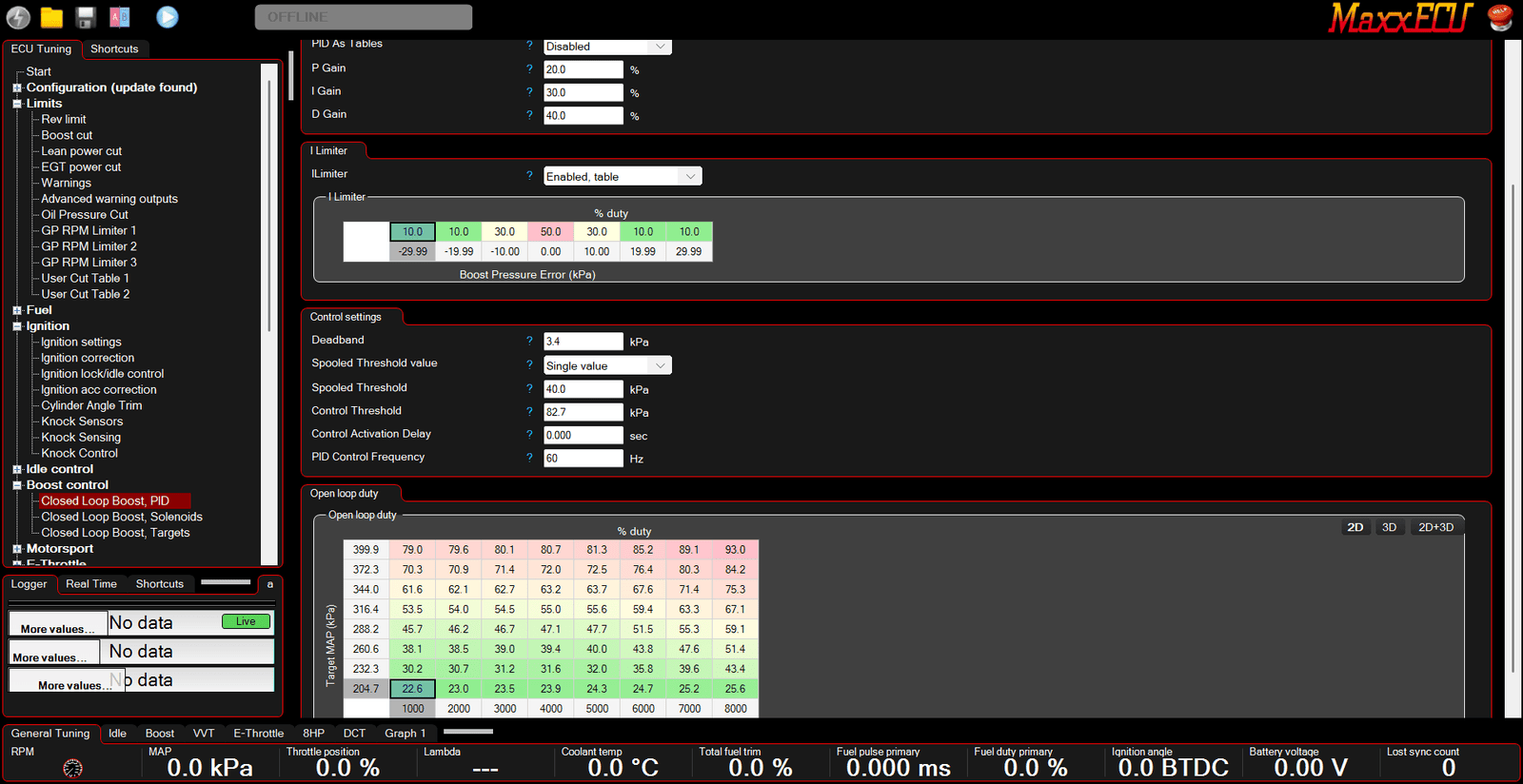
Not the step after Stage 3 — the other direction. When a build stops being something the factory ECU has a strategy for, the answer is to replace the strategy rather than argue with it. We specify, wire, map and log MaxxECU installations in house.
A swapped engine, a turbo the factory model cannot describe, ethanol, individual throttle bodies, a sensor set nobody at the factory imagined: each of these is a reason the stock ECU starts guessing. MaxxECU runs the engine on tables we build from your hardware, on a loom we can account for pin by pin.
A flash edits what the factory strategy exposes. Standalone replaces the strategy, so fuel, ignition, boost and limits are yours from a blank sheet rather than borrowed from a map somebody else locked.
Flex fuel, fuel pressure, oil pressure and temperature, EGT per cylinder, wheel speed. A factory ECU has nowhere to put them; here they are inputs the calibration can act on.
Boost by gear, by ethanol content, by intake temperature, or on a rotary switch on the dash. Target and correction, not a duty-cycle table and a hope.
Launch control, flat shift, antilag and traction control are part of the platform rather than something a factory ECU has to be tricked into approximating.
A different engine in a different chassis has no factory calibration to inherit. Standalone is how that car runs properly instead of running at all.
High-rate internal logging in MTune, and live gauges on a tablet through MDash. Every change we make on the dyno is a log you keep.
The engine decides the channel count and the rulebook decides the rest. We specify the tier against the build rather than selling up from it.
The entry into standalone management for a street car that has outgrown its factory ECU. Sequential fuel and ignition, closed-loop boost, and enough input for the sensors a road build actually runs.
More input and output than STREET, which is what a car with drive-by-wire, a second lambda and real traction control needs before the harness starts running out of pins.
The tier most of our German builds land on: enough channels to run a V8 or a straight-six fully sequential with individual cylinder trim, and the I/O for a motorsport sensor set.
For a car built to a class rather than to a road. Specify it when the rulebook, the data logging requirement or the sensor count decides the ECU rather than the engine does.
Engine, chassis, gearbox, fuel, and what the car is actually for. This decides the tier and the sensor list, and it is the conversation that stops a build being specified twice.
A plug-in adapter where one exists for the platform, and a built-to-fit loom where one does not. Motorsport-spec on request, labelled and documented either way.
Wideband lambda, fuel and oil pressure, temperatures, trigger and cam sync verified on a scope before the engine is asked to start.
Built in MTune from the engine's geometry and the injectors actually fitted, then cranked, timed and idled before it goes near a load cell.
Power is the short part. Cold start, idle, transient fuelling and part throttle are what decide whether you can live with the car afterwards.
You leave with the map, the logs, MTune on your laptop and a walkthrough of what to watch. Remote revisions afterwards are part of the build, not an extra.
Standalone management removes the factory emissions strategy and its diagnostics. A car running MaxxECU is a closed-course vehicle. We will say so on the quote, on the invoice and again at handover.
Different houses prioritise different things — staged files, drivability, gearbox logic, or full motorsport management. We match the tuner to the platform.
| Tuner | Strongest on | Main strength |
|---|---|---|
| Jackal Motorsports | Audi RS5 · RS7 | Staged and fully custom Audi work, with AL552 TCU calibration in the same package |
| Integrated Engineering | Golf R · MQB | Clean staged path to big turbo, DSG files and TrueFlex ethanol blending |
| Weistec | AMG C63 · M177 | Deep M177 experience through to upgraded turbos and CPC module tuning |
| TuneZilla | Custom / remote | Calibration developed from your logs, hardware and fuel rather than a stage file |
| MaxxECU | Motorsport builds | Standalone engine management for builds past what the factory ECU can express |
Stage 1 optimises the car you already own: boost, fuel, spark and throttle response inside the factory hardware's headroom. On an EA888.4 or a B58 that is worth +60 to +80 whp on pump fuel with nothing bolted on, which is why it is always the first flash and never the last.
The calibration runs out of air before it runs out of turbo. A high-flow downpipe, a sealed intake and better charge cooling let the factory turbo hold its boost target to redline instead of bleeding it away as intake temperatures climb. Fit the downpipe first — it returns more than any other single part on a stock-turbo car.
A larger turbocharger and the fuel system to feed it. Past this point an off-the-shelf file stops being honest: the calibration has to be developed against your hardware, your fuel and your logs, and the gearbox needs its own file to hold the torque.
We do not sell a stage number without the hardware it assumes, and we do not quote a gain we have not logged on a car. Every figure on this page came off our own dyno, back to back, on the same day.